Most buyers check the paint, the interior, and maybe the engine before they seriously consider a used car — and treat the transmission like a black box they’ll just have to trust. At Pro-Tech Transmissions, we see the other side of that decision every week: the vehicles that come in a few months after purchase with a transmission problem the buyer had no way of catching during a quick test drive around the block.
A transmission is one of the most expensive components on a vehicle to repair or replace, and it’s also one of the easiest for a seller to mask a problem in — at least for the fifteen minutes it takes to drive around the neighborhood. Here’s exactly what to check, in the order our technicians check it, before handing over money for a used car.
Start With the Fluid, Not the Test Drive
Before the engine’s even running, pull the transmission dipstick if the vehicle has one. There are two things to look for: color and smell. Healthy fluid is a clear red or pink. If it’s brown, black, or smells burnt like scorched toast, that’s not a maintenance issue — it’s a transmission that’s been running hot, and it’s telling you something the seller probably hasn’t.
This is the single most common question customers bring to our Phoenix shop: how do you check a transmission before buying a used car? Fluid condition is always the starting point, because it’s the fastest, cheapest way to catch a problem before investing any more time in a vehicle.
Drive It — Slowly, and Pay Attention to the Shifts
A test drive isn’t just about whether the car goes and stops. Pay close attention to a few specific things:
How it shifts from Park into Drive or Reverse. A hesitation of even a second before the car engages is one of the earliest warning signs of internal wear.
Whether shifts between gears are smooth or jerky. A rough, hard shift — especially one felt through the seat — usually means something’s already wearing internally.
Whether the engine revs without the car accelerating. That’s slipping, and it’s one of the clearest signs a transmission needs work.
Any delay or “hunting” between gears at steady highway speed, especially on Phoenix freeways where a vehicle holds a consistent speed for miles at a time.
Feeling any of these doesn’t necessarily mean walking away from the car — but it means not trusting the seller’s asking price at face value, and planning for a real inspection before going any further.
What Red Flags Actually Mean
Customers ask this constantly, so it’s worth stating plainly: what are red flags in a used car’s transmission? Slipping, delayed engagement, rough shifting, fluid that’s dark or burnt-smelling, a burning odor from inside the cabin during or after driving, and any warning light related to the transmission or drivetrain. None of these automatically mean walking away — but every one of them means getting the vehicle inspected before buying, full stop.
Can a Mechanic Tell If a Transmission Was Rebuilt?
This is one of the questions Pro-Tech Transmissions hears more than almost any other, because a lot of buyers assume a rebuilt transmission is automatically a red flag. It’s not — a properly rebuilt transmission with documentation and a real warranty can be just as reliable as an original one. What should raise concern is an undocumented rebuild with no paperwork and no warranty, since that usually means either the work was done cheaply, or the seller doesn’t want questions asked about it.
A qualified technician can typically tell if a transmission’s been opened up — case bolts with disturbed paint, mismatched fluid, or signs of recent work around the pan are all clues. If a seller claims a rebuild, ask for the invoice. If they can’t produce one, that’s worth factoring into an offer, or walking away entirely.
Why a Pre-Purchase Inspection Matters in Phoenix
For anyone buying a used car in the Phoenix area, a pre-purchase transmission inspection before signing anything is strongly recommended — especially if the car is coming from a private seller rather than a dealership with a real reconditioning process behind it. Arizona’s heat is brutal on transmission fluid and internal components, which means a car that spent its life here has likely seen more thermal stress than the same model would in a milder climate. A fifteen-minute test drive around a quiet neighborhood tells a buyer almost nothing about how that transmission handles sustained highway heat.
A proper inspection removes the guesswork. Pro-Tech Transmissions runs a free external computer diagnostic at both the Phoenix and Glendale shops, checking for stored codes, fluid condition, and early signs of wear — the kind of thing that genuinely can’t be caught from the driver’s seat. It’s the difference between buying a car and buying a problem that just hasn’t shown up yet.
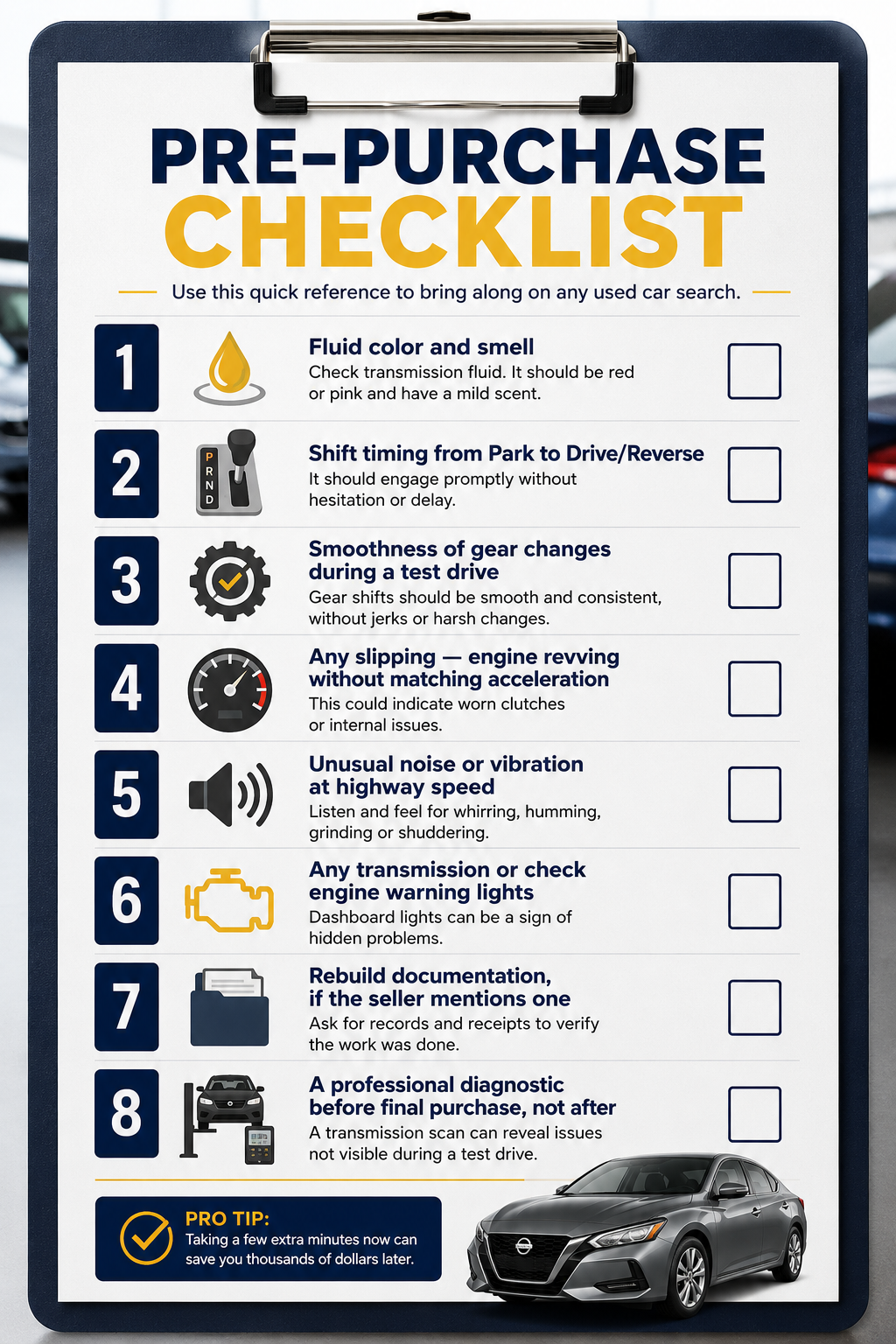
The Pre-Purchase Checklist
For a quick reference to bring along on any used car search, here’s what to check every time:
Fluid color and smell
Shift timing from Park to Drive/Reverse
Smoothness of gear changes during a test drive
Any slipping — engine revving without matching acceleration
Unusual noise or vibration at highway speed
Any transmission or check engine warning lights
Rebuild documentation, if the seller mentions one
A professional diagnostic before final purchase, not after
Too many buyers fall in love with a used car’s paint job and interior and completely skip the one component that will cost the most if it fails. A free diagnostic is a lot cheaper than a $3,000 rebuild six months after driving it off the lot. If you’d like to schedule one please contact our office today at (602)978-9201.